
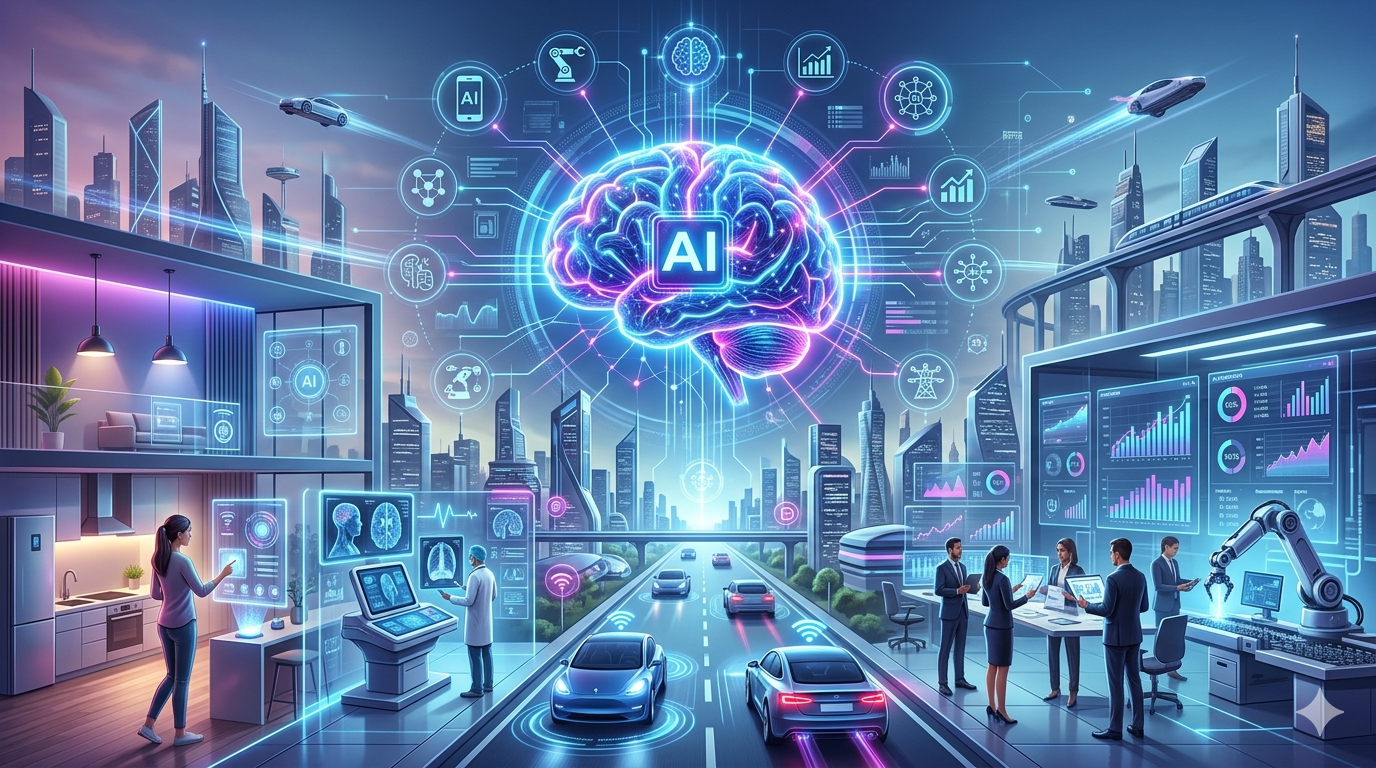
Artificial Intelligence (AI): Transforming Daily Life, Business, and the Future
Artificial Intelligence AI Transforming Daily Life Business and the Future
Introduction to Artificial Intelligence
Over the past few decades, Artificial Intelligence AI has evolved from an abstract concept into a powerful reality that shapes the modern world.
Today, AI is used in many different industries and aspects of daily life. It improves user experiences, simplifies work, increases productivity, and drives technological innovation.
As AI technology continues to develop, it is creating a future where systems become faster, smarter, and more efficient.
AI in Smartphones and Smart Devices
Modern smartphones rely heavily on AI powered features.
Voice assistants, smart cameras, face recognition, and predictive text are common examples of artificial intelligence used in daily technology.
Smartwatches also use AI for tracking heart rate, monitoring sleep patterns, calculating calorie intake, and analyzing fitness data.
AI is no longer limited to research laboratories because it has become an essential part of consumer technology used around the world.
Smart Homes and Automation
Home automation is one of the fastest growing areas of AI development.
Smart home devices such as Alexa and Google Assistant allow users to control lights, appliances, security systems, and entertainment devices through voice commands.
AI powered thermostats can automatically adjust room temperatures based on user preferences and daily habits.
In the future, smart homes are expected to become even more advanced by predicting users' needs and automating more household activities.
Artificial Intelligence in Healthcare
AI is increasingly transforming the healthcare industry.
Artificial intelligence helps doctors analyze medical scans, diagnose diseases more accurately, and conduct virtual consultations.
Hospitals use AI systems to monitor patients, process large amounts of medical data, and improve healthcare efficiency.
Robotic surgery and AI assisted medical technologies are also becoming more common due to their precision and ability to process information quickly.
Overall, healthcare quality continues to improve through these innovations.
AI in Business and Workplaces
Businesses across many industries use AI to improve operations and increase efficiency.
AI powered chatbots provide customer support, allowing companies to respond faster and improve customer service.
Predictive analytics and AI software help businesses make better decisions, manage risks, and improve planning strategies.
AI also supports remote work through automatic scheduling, transcription services, and project management tools.
As a result, organizations can improve productivity, reduce costs, and optimize daily operations.
Transportation and Autonomous Vehicles
Transportation is one of the industries experiencing major changes due to AI.
Companies such as Tesla and Waymo are developing self driving vehicles designed to make transportation safer and more efficient.
AI is also used in traffic management, ride sharing services, and delivery logistics to reduce fuel consumption and improve travel efficiency.
Future transportation systems are expected to become smarter, safer, and more environmentally friendly.
Challenges and Concerns of AI
Despite its many advantages, AI also creates important challenges.
Job automation may affect certain industries and professions, while concerns about data privacy and cybersecurity continue to grow.
Ethical questions regarding AI decision making, fairness, and responsible use are also receiving global attention.
Governments, businesses, and researchers are working on regulations and ethical frameworks to ensure AI technologies benefit society safely.
The Future of Artificial Intelligence
The future of AI technology appears extremely promising.
As technology advances, AI is expected to play an even greater role in education, healthcare, transportation, entertainment, and business.
Smarter AI systems and advanced automation could significantly improve the quality of life and transform how people work and communicate.
Responsible and ethical AI development will remain essential to ensure that the technology benefits everyone equally.
Conclusion
Artificial Intelligence is no longer science fiction. It is a real technology that continues to shape the modern world.
From smartphones and healthcare to transportation and workplaces, AI is transforming industries and daily life through innovation and automation.
Although challenges such as privacy concerns and job automation exist, the future of AI offers enormous opportunities for progress and development.
With responsible use and continuous innovation, AI has the potential to create a smarter, safer, and more connected future for humanity.